

[Distinguished] Optimal Power Flow Global Optimality, Unbalanced Power Flow, Robust Hosting Capacity
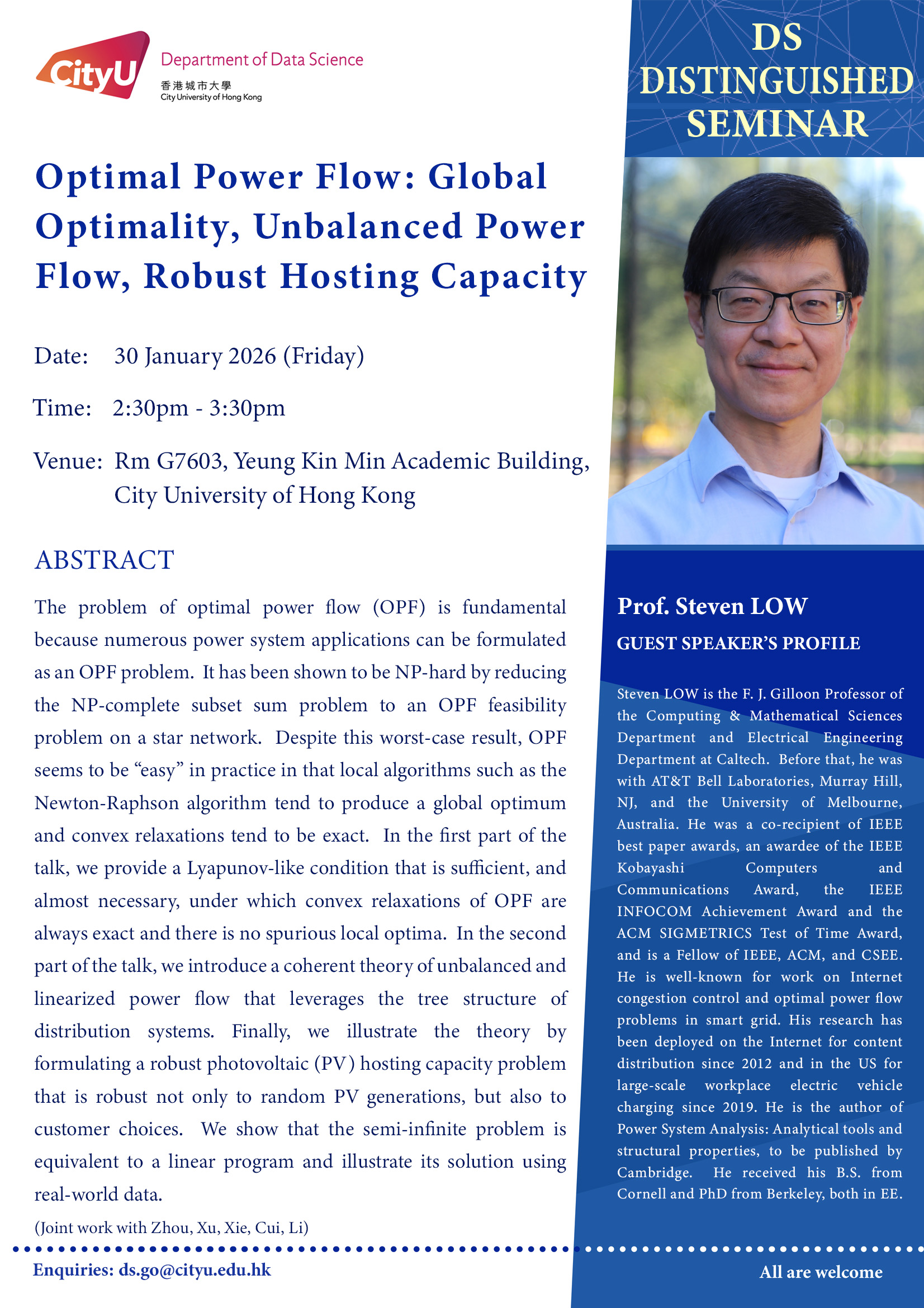
The problem of optimal power flow (OPF) is fundamental because numerous power system applications can be formulated as an OPF problem. It has been shown to be NP-hard by reducing the NP-complete subset sum problem to an OPF feasibility problem on a star network. Despite this worst-case result, OPF seems to be “easy” in practice in that local algorithms such as the Newton-Raphson algorithm tend to produce a global optimum and convex relaxations tend to be exact. In the first part of the talk, we provide a Lyapunov-like condition that is sufficient, and almost necessary, under which convex relaxations of OPF are always exact and there is no spurious local optima. In the second part of the talk, we introduce a coherent theory of unbalanced and linearized power flow that leverages the tree structure of distribution systems. Finally, we illustrate the theory by formulating a robust photovoltaic (PV) hosting capacity problem that is robust not only to random PV generations, but also to customer choices. We show that the semi-infinite problem is equivalent to a linear program and illustrate its solution using real-world data.
(Joint work with Zhou, Xu, Xie, Cui, Li)
Speaker: Prof. Steven LOW
Date: 30 Jan 2026 (Friday)
Time: 2:30pm – 3:30pm
Venue: YEUNG G7603
Poster: Click here
Biography
Prof. Steven LOW is the F. J. Gilloon Professor of the Computing & Mathematical Sciences Department and Electrical Engineering Department at Caltech. Before that, he was with AT&T Bell Laboratories, Murray Hill, NJ, and the University of Melbourne, Australia. He was a co-recipient of IEEE best paper awards, an awardee of the IEEE Kobayashi Computers and Communications Award, the IEEE INFOCOM Achievement Award and the ACM SIGMETRICS Test of Time Award, and is a Fellow of IEEE, ACM, and CSEE. He is well-known for work on Internet congestion control and optimal power flow problems in smart grid. His research has been deployed on the Internet for content distribution since 2012 and in the US for large-scale workplace electric vehicle charging since 2019. He is the author of Power System Analysis: Analytical tools and structural properties, to be published by Cambridge. He received his B.S. from Cornell and PhD from Berkeley, both in EE.