

Master of Science in Artificial Intelligence for Sciences (MSAIFS)
(Last Updated on 2 September 2026)
Normal Period of Study
Full-time: 1 year;
Part-time: 2 years
Mode of Study
Combined
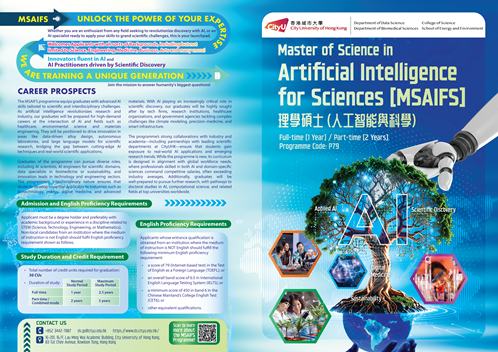
Click here to download leaflet
Programme Aims
- Offer rigorous artificial intelligence (AI) foundational training to solidify and enrich the knowledge of students in AI.
- Enable interdisciplinary knowledge development centred on AI to support students in gaining a comprehensive understanding of both AI and domain principles across various fields.
- Prepare graduates to undertake research and advanced innovative development work in industry with a focus on cultivating the skills needed to develop novel AI algorithms, enhance existing technologies, and apply these innovations to address challenges in sciences.
Programme Intended Learning Outcomes (PILOs):
Upon successful completion of this Programme, students should be able to:
- Understand theoretical foundations of contemporary AI techniques and their applications in sciences
- Apply knowledge of AI to solve problems in various fields
- Comprehend and utilize AI and computational tools to discover new knowledge and solve real-world problems in sciences
- Recognize the need for and engage in continuous learning about emerging and AI techniques and their applications in sciences
- Communicate ideas and findings effectively in written, oral, and visual forms and work in diverse, interdisciplinary team environments
Course List
Core Courses (15 credit units)
| Course Code | Course Title | Credit Units |
| DSC5001 | Statistical Machine Learning I | 3 |
| DSC6008 | Design of Experiments | 3 |
| DSC6020 | Artificial Intelligence for Scientific Knowledge Discovery | 3 |
| DSC6021 | Generative Artificial Intelligence | 3 |
| DSC6022 | Research Projects for Artificial Intelligence for Sciences | 3 |
Electives (15 credit units)
Choose one of the tracks below:
Track 1. AI for Scientific Discovery
| Course Code | Course Title | Credit Units |
| CHEM6134 | AI for Chemistry | 3 |
| PHY5503 | Introduction to Quantum Technology | 3 |
| PHY5504 | Data Acquisition & Processing Skills for Physicists I | 3 |
| PHY5505 | Data Acquisition & Processing Skills for Physicists II | 3 |
| PHY5506 | Data Analysis and Modelling in Physics | 3 |
| PHY6502 | Advanced Computational Methods for Simulation and Modelling | 3 |
| PHY6603 | Introduction to Quantum Information | 3 |
| PHY6604 | Machine Learning in Physics | 3 |
| MSE5301 | Instrumentation for Materials Characterization | 3 |
| MSE5303 | Structure and Deformation of Materials | 3 |
| MSE6181 | Photonics in Nanomaterial Systems and Devices | 3 |
| MSE6183 | Computational Methods for Materials Science | 3 |
| MSE6265 | Quantum Theory of Semiconductors | 3 |
| DSC6025 | AI for Materials Science | 3 |
Track 2. AI for Digital Medicine
| Course Code | Course Title | Credit Units |
| BMS5001 | Common Disease and Genomic Medicine | 3 |
| BMS5002 | Infectious Disease Management | 3 |
| BMS5007 | Pharmacology Principles in Drug Discovery and Development | 3 |
| BMS5008 | Fundamental and Advanced Multi-omics Research | 3 |
| BMS5009 | Ageing and the Science of Human Longevity | 3 |
| BMS5010 | Artificial Intelligence in Health Science Research and Management | 3 |
| BMS5011 | Wearable Technologies and Digital Medicine | 3 |
| BMS5012 | Nutrition Science and Stress Management | 3 |
| BMS5013 | Storytelling of Health Science Data with Analysis and Visualization | 3 |
| BMS8111 | Immunology and Infectious Diseases | 3 |
| BMS8112 | Viruses, Immunity and Ageing | 3 |
Track 3. AI for Sustainability
| Course Code | Course Title | Credit Units |
| SEE5201 | Air Pollution and Atmospheric Chemistry | 3 |
| SEE5202 | Climate Change: Science, Adaptation and Mitigation | 3 |
| SEE5211 | Data Analysis in Environmental Applications | 3 |
| SEE5212 | Environmental Pollution: Theories, Measurement and Mitigation | 3 |
| SEE6101 | Energy Generation and Storage Systems | 3 |
| SEE6103 | Energy Conversion: Theory and Methodology | 3 |
| SEE6104 | Energy Conservation and Audit | 3 |
| SEE6115 | Carbon Audit and Management | 3 |
| SEE6118 | Emerging Energy Technologies | 3 |
| SEE6122 | Advanced Thermosciences for Energy Engineering | 3 |
| SEE6124 | Fuel Processing | 3 |
| SEE6125 | Carbon Capture Use and Storage | 3 |
| SEE6212 | Environmental Modelling | 3 |
| SEE6213 | Wastewater Engineering and Water Quality Assessment | 3 |
| SEE6214 | Solid Waste Treatment and Management | 3 |
| SEE6224 | Environmental Engineering Science | 3 |
| SEE6225 | Environmental Assessment | 3 |
Track 4. Applied AI
| Course Code | Course Title | Credit Units |
| DSC6004 | Topics of Artificial Intelligence for Smart Cities | 3 |
| DSC6019 | Embodied AI and Applications | 3 |
| DSC6026 | Social Network Analysis | 3 |
| DSC6027 | Topics of AI for Computational Social Sciences | 3 |
| DSC6028 | Medical Image and Analysis | 3 |
| DSC6029 | Topics of Artificial Intelligence for Biomedical Studies | 3 |
| DSC6030 | Quantum Machine Learning | 3 |
Dissertation and Internship Courses
| Course Code | Course Title | Credit Units |
| DSC6023 | Internship in Artificial Intelligence for Sciences | 3 |
| DSC6024 | Dissertation for Artificial Intelligence for Sciences | 6 |
Remarks:
- Students can participate in experiential learning in the focused track by taking either a two-semester Dissertation course (6 CUs) in the first year in Semester B and Summer Term, or an Internship course (3 CUs) in the Summer Term of the first year.
- All the dissertation and internship courses are mutually exclusive.
- The normal study period will be one year to complete 30 CUs in full-time mode. Students who plan to take the Internship course will have to complete 27 CUs in Semester A and Semester B first, before taking the Internship course (3 CUs) in the Summer Term.
- Students enrolled in the Internship course are not allowed to register for any other courses during Summer Term.
- While students are expected to look for internship opportunities by themselves, potential internship opportunities* might be available to students.
*Subject to Department's and collaborating organisations' mutual consent/ actual arrangements.
Selection guidelines:
Applicants must submit a Track Selection Statement to indicate their chosen track among the four tracks provided in this programme. This statement must be a one-page PDF file and include two elements:
(1) Chosen track: Clearly state which of the four tracks you are applying for,
(2) Explanation: Provide concise reasons for your choice. A brief paragraph is sufficient.
The normal study period will be one year to complete 30 CUs in full-time mode. Students have the option to complete 27 CUs in Semester A and Semester B, and take an Internship course (3 CUs) in the Summer Term.
Students enrolled in the Internship course may not register for any other courses during that term.
Student Handbook
Admission Requirements
Applicant must be a degree holder and preferably with academic background or experience in a discipline related to STEM (Science, Technology, Engineering, or Mathematics).
Applicants whose entrance qualification is obtained from an institution where the medium of instruction is not English should fulfil the following minimum English proficiency requirement:
- a score of 79 (for tests taken prior to 21 January 2026) or 4 (for tests taken from 21 January 2026 onwards) (Internet-based Test) in the Test of English as a Foreign Language (TOEFL)@#; or
- an overall band score of 6.0 in International English Language Testing System (IELTS)@#; or
- a minimum score of 450 in the Chinese Mainland’s College English Test (CET-6); or
- other equivalent qualifications
@ TOEFL and IELTS scores are considered valid for two years. Applicants are required to provide their English test results obtained within the two years preceding the start of the University's application period. 'TOEFL iBT Home Edition', ‘TOEFL MyBest Score’, ‘IELTS Indicator’, ‘IELTS One Skill Retake’ and ‘IELTS Online’ are not acceptable. All TOEFL results must be sent directly by the Educational Testing Service (ETS) using CityUHK’s institution code 3401, while IELTS results must be sent via the IELTS Results Service e-delivery to 'City University of Hong Kong - Graduate School'.
# Applicants with an IELTS overall band score of 6.0 or a TOEFL overall score of 4 will be required to pass an interview for English proficiency conducted by the concerned academic unit. Applicants with a comparable overall score of 79 or above shown on the TOEFL report may be exempt from the interview requirement. Interviews for other applicants may not be required.
Tuition Fees
Please refer to School of Graduate Studies (SGS) admission website:
Credit Units Required for Graduation: 30
| Duration of study: | |
| Normal Study Period | Maximum Study Period |
| 1 year (Full-time) | 2.5 years (Full-time) |
| 2 years (Part-time/Combined mode) | 5 years (Part-time/Combined mode) |
Career Prospects
The programme equips graduates with advanced Al skills tailored to scientific and interdisciplinary challenges. As artificial intelligence revolutionizes research and industry, our graduates will be prepared for high-demand careers at the intersection of Al and fields such as healthcare, environmental science, materials engineering, and social analytics. They will be positioned to drive innovation in areas like data-driven alloy design, autonomous laboratories, and large language models for scientific research, bridging the gap between cutting-edge Al techniques and real-world scientific applications.
Graduates of the programme can pursue diverse roles, including Al scientists, Al engineers for scientific domains, data specialists in biomedicine or sustainability, and innovation leads in technology and engineering sectors. The programme's interdisciplinary nature ensures that students develop expertise applicable to industries such as biotechnology, energy, digital medicine, and advanced materials. With Al playing an increasingly critical role in scientific discovery, our graduates will be highly sought after by tech firms, research Institutions, healthcare organisations, and government agencies tackling complex challenges like climate modeling, precision medicine, and smart infrastructure.
The programme's strong collaborations with industry and academia-including partnerships with leading scientific and engineering departments at CityUHK-ensure that students gain exposure to real-world Al applications and emerging research trends. While the programme is new its curriculum is designed in alignment with global workforce needs, where professionals skilled in Al and domain-specific sciences command competitive salaries, often exceeding industry averages Additionally, graduates will be well-prepared to pursue further research, with pathways to doctoral in Al, computational science, and related fields at top universities worldwide.
Contact Us
For general enquiries, please contact the Department of Data Science (DS) at ds.go@cityu.edu.hk
For application enquiries, please contact the School of Graduate Studies (SGS) at tpadmit@cityu.edu.hk
For student visa matters, please contact the Admissions Office at admovisa@cityu.edu.hk