

[Distinguished] Data Analytics and Optimization for Manufacture-Circulation Industrial System
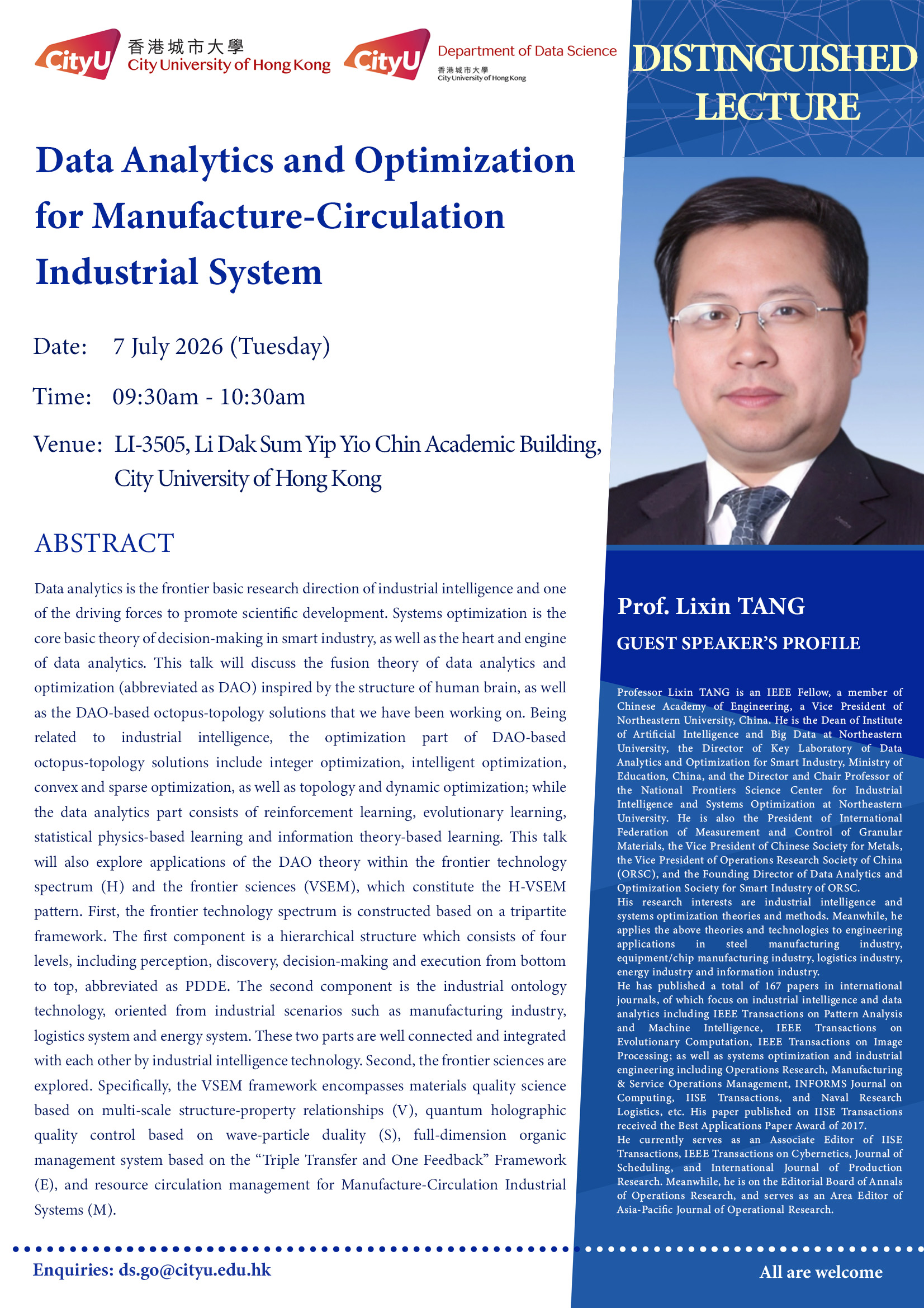
Data analytics is the frontier basic research direction of industrial intelligence and one of the driving forces to promote scientific development. Systems optimization is the core basic theory of decision-making in smart industry, as well as the heart and engine of data analytics. This talk will discuss the fusion theory of data analytics and optimization (abbreviated as DAO) inspired by the structure of human brain, as well as the DAO-based octopus-topology solutions that we have been working on. Being related to industrial intelligence, the optimization part of DAO-based octopus-topology solutions include integer optimization, intelligent optimization, convex and sparse optimization, as well as topology and dynamic optimization; while the data analytics part consists of reinforcement learning, evolutionary learning, statistical physics-based learning and information theory-based learning. This talk will also explore applications of the DAO theory within the frontier technology spectrum (H) and the frontier sciences (VSEM), which constitute the H-VSEM pattern. First, the frontier technology spectrum is constructed based on a tripartite framework. The first component is a hierarchical structure which consists of four levels, including perception, discovery, decision-making and execution from bottom to top, abbreviated as PDDE. The second component is the industrial ontology technology, oriented from industrial scenarios such as manufacturing industry, logistics system and energy system. These two parts are well connected and integrated with each other by industrial intelligence technology. Second, the frontier sciences are explored. Specifically, the VSEM framework encompasses materials quality science based on multi-scale structure-property relationships (V), quantum holographic quality control based on wave-particle duality (S), full-dimension organic management system based on the “Triple Transfer and One Feedback” Framework (E), and resource circulation management for Manufacture-Circulation Industrial Systems (M).
Speaker: Prof. Lixin TANG
Date: 7 Jul 2026 (Tuesday)
Time: 09:30am – 10:30am
Venue: LI 3505
Poster: Click here
Biography
Professor Lixin TANG is an IEEE Fellow, a member of Chinese Academy of Engineering, a Vice President of Northeastern University, China. He is the Dean of Institute of Artificial Intelligence and Big Data at Northeastern University, the Director of Key Laboratory of Data Analytics and Optimization for Smart Industry, Ministry of Education, China, and the Director and Chair Professor of the National Frontiers Science Center for Industrial Intelligence and Systems Optimization at Northeastern University. He is also the President of International Federation of Measurement and Control of Granular Materials, the Vice President of Chinese Society for Metals, the Vice President of Operations Research Society of China (ORSC), and the Founding Director of Data Analytics and Optimization Society for Smart Industry of ORSC.
His research interests are industrial intelligence and systems optimization theories and methods. Meanwhile, he applies the above theories and technologies to engineering applications in steel manufacturing industry, equipment/chip manufacturing industry, logistics industry, energy industry and information industry.
He has published a total of 167 papers in international journals, of which focus on industrial intelligence and data analytics including IEEE Transactions on Pattern Analysis and Machine Intelligence, IEEE Transactions on Evolutionary Computation, IEEE Transactions on Image Processing; as well as systems optimization and industrial engineering including Operations Research, Manufacturing & Service Operations Management, INFORMS Journal on Computing, IISE Transactions, and Naval Research Logistics, etc. His paper published on IISE Transactions received the Best Applications Paper Award of 2017.
He currently serves as an Associate Editor of IISE Transactions, IEEE Transactions on Cybernetics, Journal of Scheduling, and International Journal of Production Research. Meanwhile, he is on the Editorial Board of Annals of Operations Research, and serves as an Area Editor of Asia-Pacific Journal of Operational Research.