

SpectraAI: AI-Driven Molecular Identification and Discovery
Molecular identification and discovery play a pivotal role in biochemical analysis, environmental governance, customs inspection, and other critical fields. Spectroscopic instruments, including mass spectrometry, infrared spectroscopy, nuclear magnetic resonance (NMR) spectroscopy, and X-ray spectroscopy, are fundamental tools for exploring the microscopic molecular world.
However, current spectroscopic data analysis methods for molecular identification and discovery primarily rely on database searching and human professional expertise. These approaches face inherent limitations: they struggle to identify and discover novel molecules beyond existing databases, while suffering from low analysis efficiency, poor accuracy, and high costs. To address these challenges, we have conducted systematic research, exploration, and system development across multiple dimensions: data collection and cleaning, the development of a family of spectroscopic large foundation models, the creation of AI Agents for spectroscopic analysis, algorithm design grounded in biochemical principles, and practical application deployment in biomedicine and environmental protection. In this talk, I will elaborate on the research framework of SpectraAI and its latest progress, while highlighting promising research directions for future.
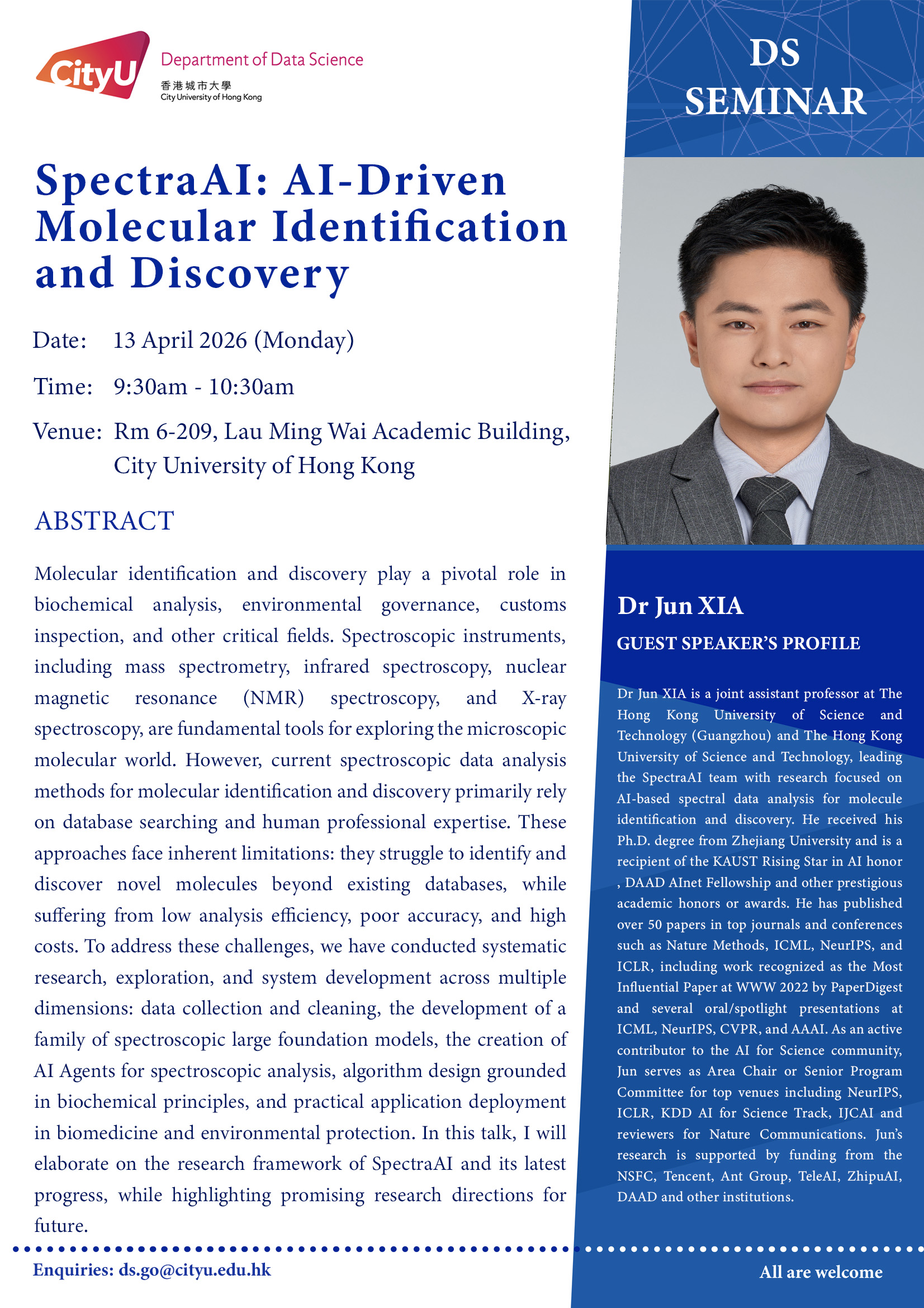
Speaker: Dr. Jun XIA
Date: 13 Apr 2026 (Monday)
Time: 9:30am – 10:30am
Venue: LAU 6-209
Poster: Click here
Biography
Dr Jun XIA is a joint assistant professor at The Hong Kong University of Science and Technology (Guangzhou) and The Hong Kong University of Science and Technology, leading the SpectraAI team with research focused on AI-based spectral data analysis for molecule identification and discovery. He received his Ph.D. degree from Zhejiang University and is a recipient of the KAUST Rising Star in AI honor , DAAD AInet Fellowship and other prestigious academic honors or awards. He has published over 50 papers in top journals and conferences such as Nature Methods, ICML, NeurIPS, and ICLR, including work recognized as the Most Influential Paper at WWW 2022 by PaperDigest and several oral/spotlight presentations at ICML, NeurIPS, CVPR, and AAAI. As an active contributor to the AI for Science community, Jun serves as Area Chair or Senior Program Committee for top venues including NeurIPS, ICLR, KDD AI for Science Track, IJCAI and reviewers for Nature Communications. Jun’s research is supported by funding from the NSFC, Tencent, Ant Group, TeleAI, ZhipuAI, DAAD and other institutions.