

Beyond Black-Box Scaling: Interpretability Algorithms and GPUs
As machine learning becomes more widespread, it is increasingly used to support high-stakes decisions in domains such as healthcare and scientific discovery. However, as models become larger and more complex, we often lose control: black-box models can be difficult to troubleshoot, constrain with domain requirements, and trust in deployment. How can we extract actionable insights beyond prediction, and how can we better leverage today's growing compute to do so?
This talk explores an alternative route: scaling optimization while shrinking model complexity, especially for problems with discrete structure --- often yielding 10--100x reductions in training time relative to traditional approaches. First, I will show how scalable discrete optimization can learn interpretable medical scoring systems from modern real-world datasets that achieve black-box-level accuracy while remaining deployable as simple, auditable, and interactive decision tools. Second, I will describe how GPU-compatible methods make it practical to obtain certifiably optimal solutions for highly nonconvex, combinatorial problems, enabling new capabilities such as discovering governing differential equations from data in physical science.
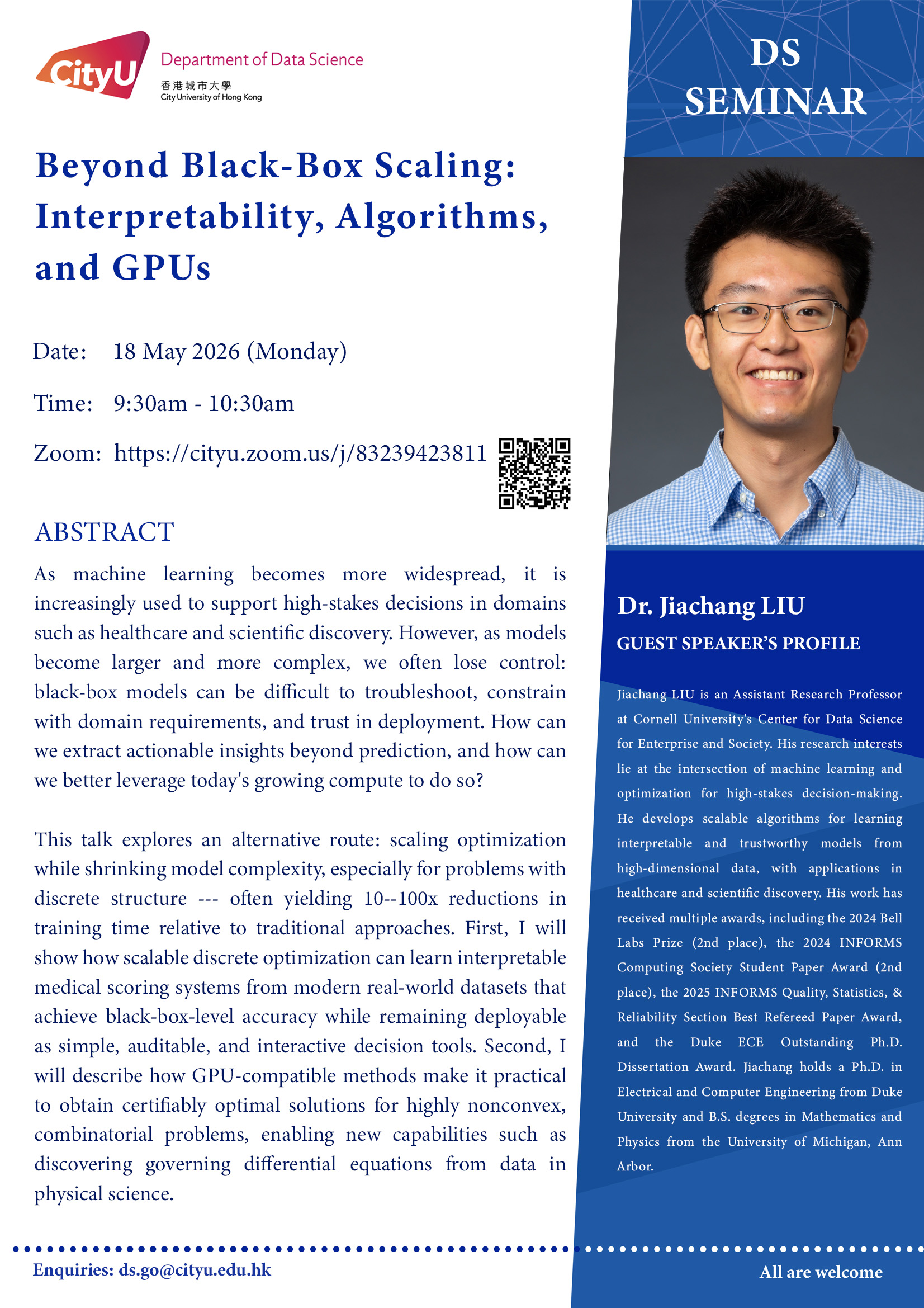
Speaker: Dr. Jiachang LIU
Date: 18 May 2026 (Monday)
Time: 9:30am – 10:30am
Zoom: Link
Poster: Click here
Biography
Jiachang LIU is an Assistant Research Professor at Cornell University's Center for Data Science for Enterprise and Society. His research interests lie at the intersection of machine learning and optimization for high-stakes decision-making. He develops scalable algorithms for learning interpretable and trustworthy models from high-dimensional data, with applications in healthcare and scientific discovery. His work has received multiple awards, including the 2024 Bell Labs Prize (2nd place), the 2024 INFORMS Computing Society Student Paper Award (2nd place), the 2025 INFORMS Quality, Statistics, & Reliability Section Best Refereed Paper Award, and the Duke ECE Outstanding Ph.D. Dissertation Award. Jiachang holds a Ph.D. in Electrical and Computer Engineering from Duke University and B.S. degrees in Mathematics and Physics from the University of Michigan, Ann Arbor.