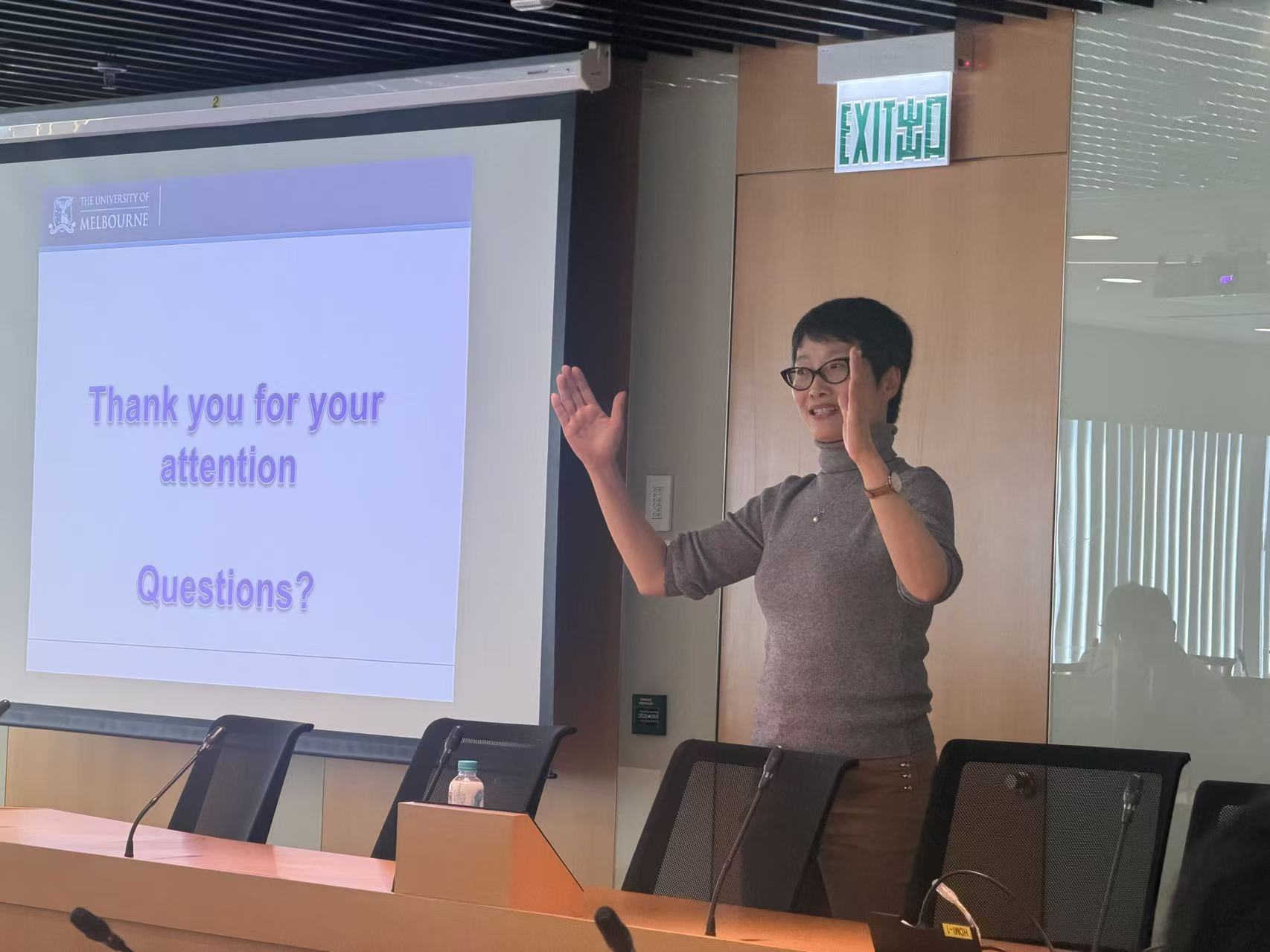

The Department of Data Science (DS) at City University of Hong Kong (CityUHK) hosted a DS Distinguished Seminar featuring Prof. Ying TAN from The University of Melbourne. Prof. Tan delivered a talk entitled “Learning Control and Its Application in Rehabilitation Robotics”, sharing insights into how learning-based control strategies can enhance robot-assisted rehabilitation through data-driven performance improvement.
In her seminar, Prof. Tan highlighted the “practice makes perfect” principle underlying modern rehabilitation, where repetitive, task-oriented exercises support motor re-learning and functional recovery—particularly in post-stroke rehabilitation. She noted that rehabilitation robotics can provide intensive, measurable and personalised training, but achieving effective assistance requires control algorithms that can continuously adapt to human variability and interaction dynamics. This motivates the use of Learning Control (LC), a class of learning control methods designed for systems that execute tasks repeatedly.
Prof. Tan introduced the core idea of LC: by leveraging tracking errors and input–output data from previous repetitions, the controller updates the control input for subsequent trials, enabling performance to improve over iterations. She outlined three typical LC paradigms, including feedforward, data-driven LC, and error-feedback learning control frameworks, and discussed how these designs can be applied to rehabilitation robotics in the presence of modelling uncertainties and time-varying human–robot coupling.
The seminar also addressed key challenges in translating learning control to real-world rehabilitation settings, such as safety and compliance requirements, the time-varying nature of human motor behaviour, and the design of feedback strategies that balance guidance with patients’ active participation. The talk prompted an engaging discussion among participants on future directions at the intersection of learning control, data-driven modelling, wearable sensing and human-centred robotics.