

From Real-Time 3D/4D Reconstruction to Generative World Models
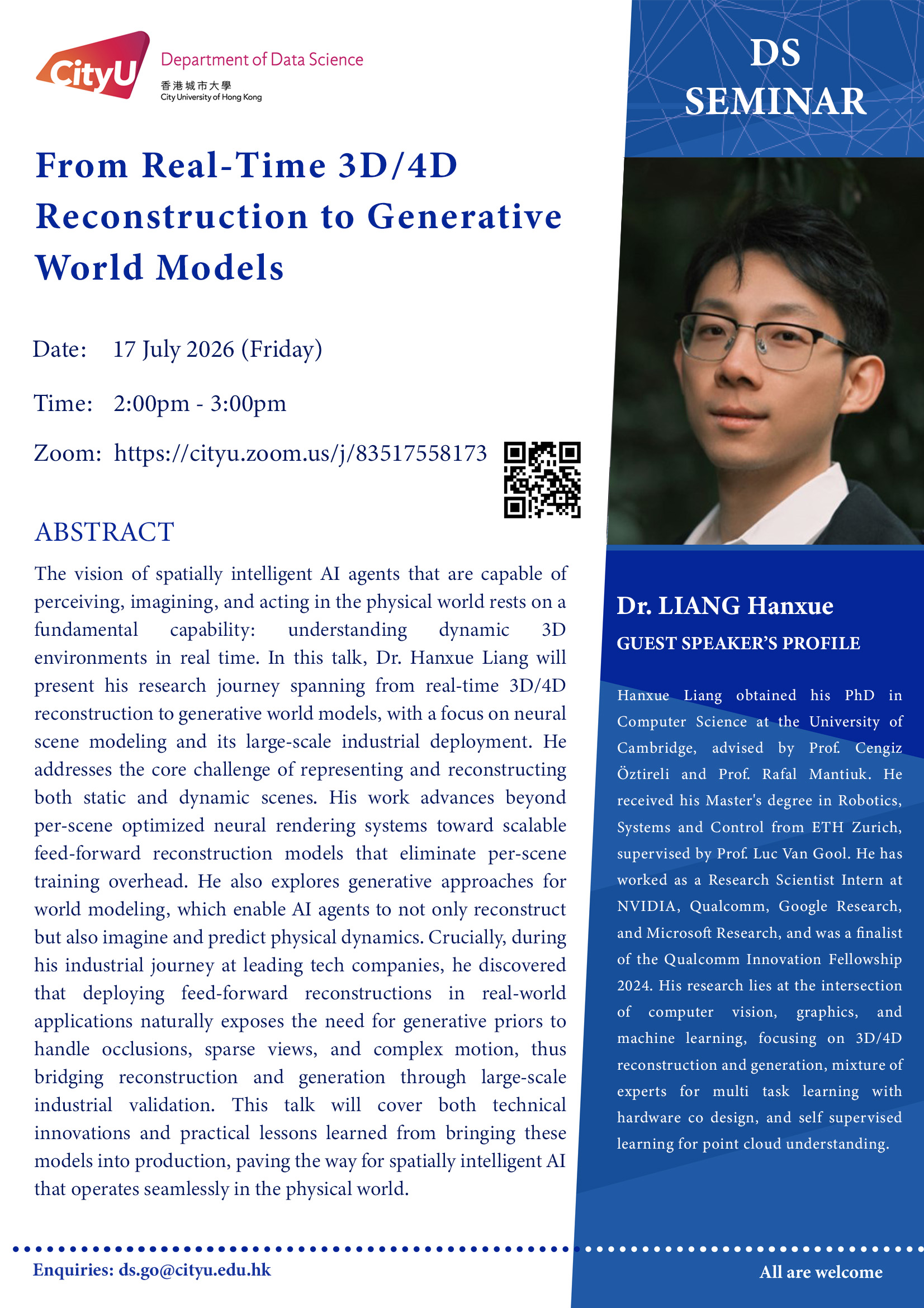
The vision of spatially intelligent AI agents that are capable of perceiving, imagining, and acting in the physical world rests on a fundamental capability: understanding dynamic 3D environments in real time. In this talk, Dr. Hanxue Liang will present his research journey spanning from real-time 3D/4D reconstruction to generative world models, with a focus on neural scene modeling and its large-scale industrial deployment. He addresses the core challenge of representing and reconstructing both static and dynamic scenes. His work advances beyond per-scene optimized neural rendering systems toward scalable feed-forward reconstruction models that eliminate per-scene training overhead. He also explores generative approaches for world modeling, which enable AI agents to not only reconstruct but also imagine and predict physical dynamics. Crucially, during his industrial journey at leading tech companies, he discovered that deploying feed-forward reconstructions in real-world applications naturally exposes the need for generative priors to handle occlusions, sparse views, and complex motion, thus bridging reconstruction and generation through large-scale industrial validation. This talk will cover both technical innovations and practical lessons learned from bringing these models into production, paving the way for spatially intelligent AI that operates seamlessly in the physical world.
Speaker: Dr.Hanxue LIANG
Date: 17 Jul 2026 (Friday)
Time: 2:00pm – 3:00pm
Venue: Link
Poster: Click here
Biography
Dr. Hanxue LIANG obtained his PhD in Computer Science at the University of Cambridge, advised by Prof. Cengiz Öztireli and Prof. Rafal Mantiuk. He received his Master's degree in Robotics, Systems and Control from ETH Zurich, supervised by Prof. Luc Van Gool. He has worked as a Research Scientist Intern at NVIDIA, Qualcomm, Google Research, and Microsoft Research, and was a finalist of the Qualcomm Innovation Fellowship 2024. His research lies at the intersection of computer vision, graphics, and machine learning, focusing on 3D/4D reconstruction and generation, mixture‑of‑experts for multi‑task learning with hardware co‑design, and self‑supervised learning for point cloud understanding.