

[Distinguished] Computational Methods and Resources for Multi-omics Understanding of Complex Human Systems
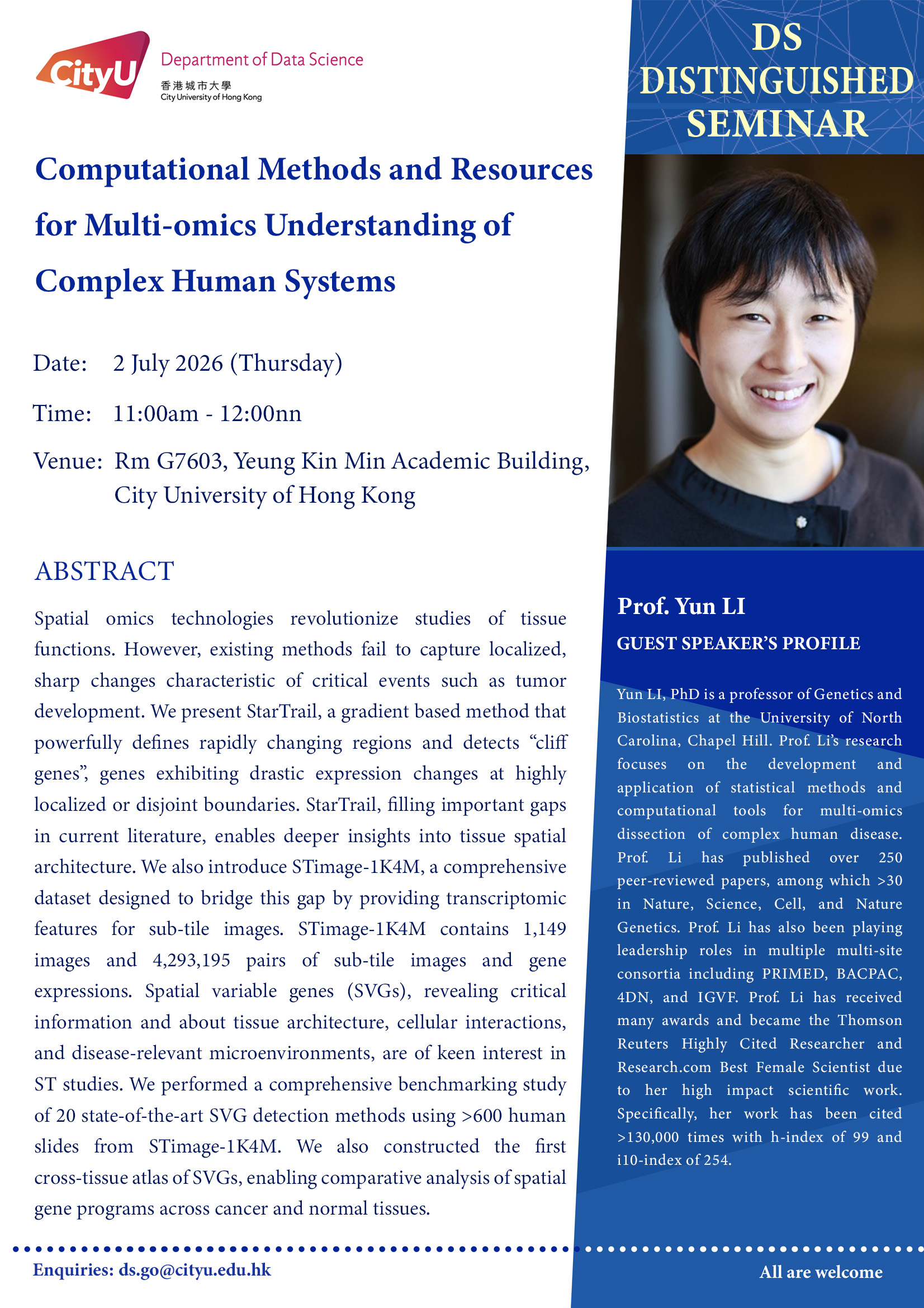
Spatial omics technologies revolutionize studies of tissue functions. However, existing methods fail to capture localized, sharp changes characteristic of critical events such as tumor development. We present StarTrail, a gradient based method that powerfully defines rapidly changing regions and detects “cliff genes”, genes exhibiting drastic expression changes at highly localized or disjoint boundaries. StarTrail, filling important gaps in current literature, enables deeper insights into tissue spatial architecture. We also introduce STimage-1K4M, a comprehensive dataset designed to bridge this gap by providing transcriptomic features for sub-tile images. STimage-1K4M contains 1,149 images and 4,293,195 pairs of sub-tile images and gene expressions. Spatial variable genes (SVGs), revealing critical information and about tissue architecture, cellular interactions, and disease-relevant microenvironments, are of keen interest in ST studies. We performed a comprehensive benchmarking study of 20 state-of-the-art SVG detection methods using >600 human slides from STimage-1K4M. We also constructed the first cross-tissue atlas of SVGs, enabling comparative analysis of spatial gene programs across cancer and normal tissues.
Speaker: Prof. Yun LI
Date: 2 Jul 2026 (Thursday)
Time: 11:00am – 12:00nn
Venue: YEUNG G7603
Poster: Click here
Biography
Yun Li, PhD is a professor of Genetics and Biostatistics at the University of North Carolina, Chapel Hill. Prof. Li’s research focuses on the development and application of statistical methods and computational tools for multi-omics dissection of complex human disease. Prof. Li has published over 250 peer-reviewed papers, among which >30 in Nature, Science, Cell, and Nature Genetics. Prof. Li has also been playing leadership roles in multiple multi-site consortia including PRIMED, BACPAC, 4DN, and IGVF. Prof. Li has received many awards and became the Thomson Reuters Highly Cited Researcher and Research.com Best Female Scientist due to her high impact scientific work. Specifically, her work has been cited >130,000 times with h-index of 99 and i10-index of 254.